
The journal
A storybook, rebuilt in 3D: making the Aisha Jewels Ramadan film.
Published 12 May 2026
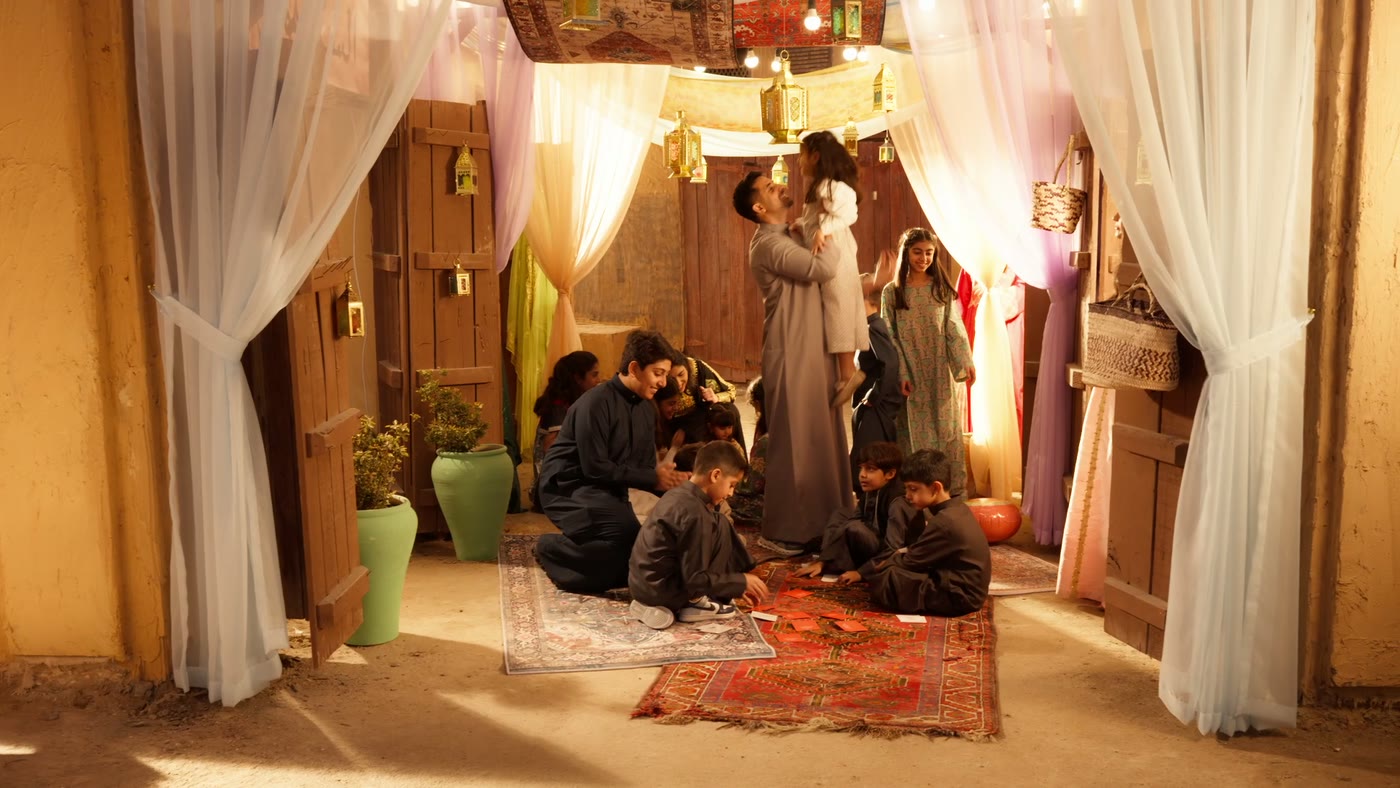
Some briefs ask for a video. Some ask for a feeling. Aisha Jewels came to us before Ramadan with the second kind: gold passed between generations, memory you can wear, a story that should feel like it was read aloud to you as a child.
You can't shoot that brief with a camera alone. So we didn't.
Choosing the storybook
The earliest creative decision was the one everything else hung on: the film would be a storybook. Pages, chapters, a world that turns rather than cuts. That single choice told us the palette (warm, lamplit), the pacing (page-turns, not jump cuts), and the technique (live action woven into 3D-built environments, with VFX doing the stitching).
This is the part of filmmaking that never shows up in a shot list. The idea is the production plan. Choose "storybook" and you've chosen your entire pipeline.
Live action where it matters, 3D where it counts
The instinct on jewellery films is to point a macro lens at the product and let it sparkle. But sparkle isn't a story. We put the budget where the emotion lives: real people, real hands, a real family gathered, then built the impossible parts, the world that wraps around them, in 3D.
The rule we kept coming back to: if the audience should feel it, shoot it. If the audience should marvel at it, build it. Mixing the two is where the craft gets unforgiving. Light direction, shadow softness and lens behaviour have to agree between the shot footage and the rendered world, or the seam shows and the spell breaks.
The unglamorous middle
Between the treatment and the final grade sits the part nobody posts about: matching a virtual camera to a real one. Rebuilding a set digitally because a page-turn transition needed geometry that didn't exist. Rendering overnight, reviewing at breakfast, adjusting, rendering again. A three-minute film is a thousand small agreements between departments.
Our behind-the-scenes folder from those weeks is mostly photos of people staring at monitors. That's what VFX-heavy production honestly looks like.
What made it land
When the film went out during Ramadan, the response wasn't "nice graphics." It was people tagging family. That's the only KPI a film like this really has. It aimed at memory and hit it.
The craft lesson we took into every film since: technique should be invisible in the best way. Nobody watching a storybook thinks about the binding. They just want the next page.
The finished film and stills live in the Aisha Jewels case study.
Direction, 3D, VFX and finishing, all in-house. Bring us the impossible brief.