
The journal
Real people, real roles.
Published 30 August 2026
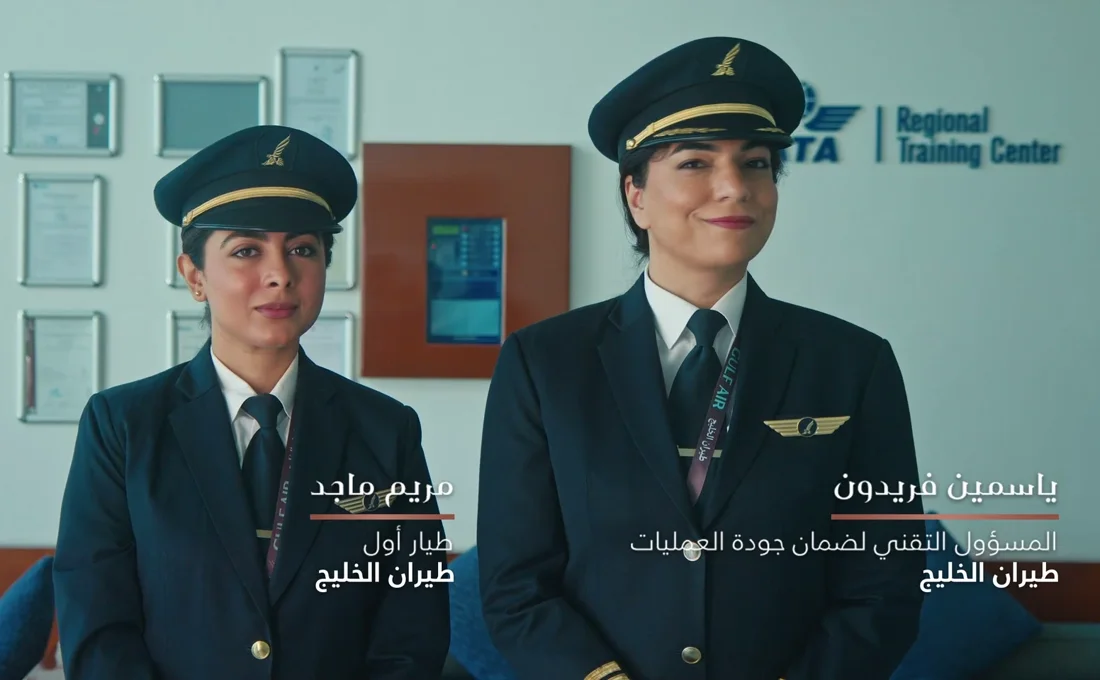
There's a version of every national campaign that gets made in a casting studio. Photogenic faces, wardrobe from a rack, a location dressed to look like a workplace. It's efficient, it's controllable, and audiences see through it in one frame — because the point of a national campaign is the nation, and the nation knows its own people.
We've spent four years making the other version.
Actors perform. People testify.
When Mumtalakat asked us to tell the story of Bahraini women across its portfolio, the brief could have been solved with a day in a studio. Instead we filmed a real pilot at Gulf Air, a real engineer at Alba, a real coder at Beyon, a real professor at AUBH — women doing on camera what they do every other day of the year. The full series is in the Mumtalakat case study.
The difference isn't subtle. An actor gives you a performance of competence. A professional gives you the real thing: the way a pilot's hands actually move through a pre-flight check, the shorthand between engineers who have worked a line together for years. You cannot direct that in. You can only go where it lives and film it.
The logistics are the craft
The honest version costs more in planning than in talent. The 2024 edition ran seven shoot days across thirteen locations — active workplaces, not sets. Smelters and server rooms don't pause for a crew, so the crew works around the shift pattern, keeps its footprint small, and earns the access it's been given.
Then the edit has to hold it together. Match cuts and timelapses stitch a pilot, an engineer, a coder and a professor into one motion — a whole economy reading as a single story. That's the trade: you give up the control of a studio and win it back in structure.
One idea, told honestly, travels
Honesty also scales better than it looks. The Women's Day brief that started with Gulf Air became six films across the group — Gulf Air, Alba, Danat, Edamah, Mumtalakat and a combined edit — one idea told six ways without repeating itself, because every company supplied its own true people and places.
Bapco Energies proved the other axis: repeatability. Three Women's Day editions, 2022 through 2024, each built on real employees, delivered horizontal for screens and vertical for feeds. And when the brief is a national moment rather than a workforce — Bahrain Sports Day — the same rule holds: build the film around real people in motion and it feels like the day itself.
What this means for your brief
Budget for access, not talent. The recce, the permissions, the shift-friendly schedule — that's where the money works hardest.
Brief for people, not scripts. Find the pilot, the engineer, the coder. Their reality will beat anything written for them.
Design the edit before the shoot. Real locations don't repeat. Match cuts, timelapses and format plans — 16:9 and 9:16 from day one — are decided at the recce, not in post. (More on that discipline: shoot once, cut forever.)
The result is a film the people in it will share — which, for a national campaign, is the whole point.
Planning a campaign that speaks for more than a product? Start with a conversation.